Message congruence
Dissertation. When what is said and what is shown disagree, or when one nonverbal channel contradicts another, how do people notice, and what do they conclude? I am building a theory of congruence between messages.
Ph.D. Candidate · Communication · UC Santa Barbara
I study how kinesics (the face and the body), the voice and words combine into a single message, and what people do when they don’t agree.
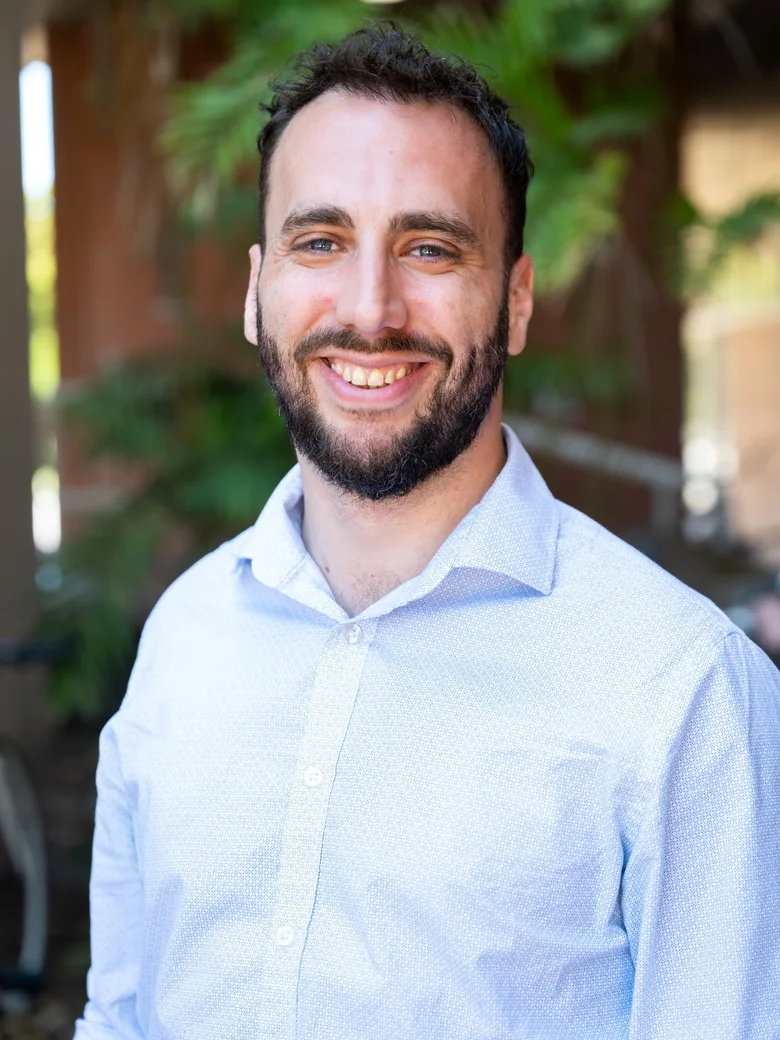
↑ 00:13–00:18: the channels align. My dissertation asks what perceivers do when they don’t.
00:12
Theory construction and multimodal measurement in nonverbal communication.
Dissertation. When what is said and what is shown disagree, or when one nonverbal channel contradicts another, how do people notice, and what do they conclude? I am building a theory of congruence between messages.
What passion looks and sounds like, and how to measure it computationally from video.
WAGS/ProQuest thesis award 2025 · NCA Top Paper 2026With Ronald E. Riggio: nonverbal skills as abilities that can fail in both directions, and calibration as their essential core.
Three book chapters, 2022–in pressTrust and power in teams playing a cooperative game, how exoskeletons change interpersonal dynamics, moral reasoning across large language models, and the moral signatures of elite political messages.
HICSS Top Paper 2026Dunbar, N. E., Terzi, H., & Crawley, A. Behavioral observation and relational turbulence: From coding schemes to computational analysis. In J. A. Theiss, R. M. McLaren, L. K. Knobloch, & D. H. Solomon (Eds.), The Cambridge handbook of relational turbulence. Cambridge University Press.
Crawley, A., & Riggio, R. E. The essential core of nonverbal skills: Calibration. In A. Kostić & D. Chadee (Eds.), The social psychology of nonverbal communication (2nd ed.). Palgrave Macmillan.
Crawley, A., & Riggio, R. E. Emotions expressed in body movements, postures, gait, and dance. In D. Chadee & A. Kostić (Eds.), Body language communication. Palgrave Macmillan. doi:10.1007/978-3-031-70064-4_10
Riggio, R. E., & Crawley, A. Nonverbal skills in relationships: Too little or too much may be a bad thing. In R. J. Sternberg & A. Kostić (Eds.), Nonverbal communication in close relationships: What words don’t tell us (pp. 341–361). Palgrave Macmillan. doi:10.1007/978-3-030-94492-6
Oliver, A., Crawley, A., De, S., & Jeay-Bizot, L. Mapping the moral foundations of machines: A vignette-based inquiry into moral reasoning across six large language model platforms. In T. X. Bui (Ed.), Proceedings of the 59th Hawaii International Conference on System Sciences. doi:10.24251/HICSS.2026.482Top Paper
Crawley, A. Clap, clap, clap: Unsystematic review essay on clapping and applause. Integrative Psychological and Behavioral Science. doi:10.1007/s12124-023-09786-9
Cestero Mancera, A. M., & Crawley, A. Desarrollo multidisciplinar de los estudios de comunicación no verbal en el siglo XXI: Una gran deuda con Fernando Poyatos. Anejos de la revista Oralia, 7, 19–62.
Rodríguez Quiroga, A., Aufenacker, S., Crawley, A., et al. A multicentre study: Comparison of 3-LM group output and therapeutic outcome measures. Adding to the trustworthiness of the 3-LM? Part 2. The International Journal of Psychoanalysis, 104(1), 96–121.
Rodríguez Quiroga, A., Juan, S., Waldron, S., et al. Qualitative multi-centered study: Trustworthiness of the three-level model (3-LM), Part 1. The International Journal of Psychoanalysis, 104(1), 69–95.
Rodríguez Quiroga, A., Aufenacker, S. I., Bongiardino, L., & Crawley, A. Capacidad de mentalización y soledad en estudiantes de psicología de la Universidad del Salvador durante y después de la cuarentena por COVID-19. Anuario de Investigación USAL, (9).
Rodríguez Quiroga de Pereira, A., Bongiardino, L., Borensztein, L., Botero, C., Crawley, A., Vázquez, N., & Aufenacker, S. I. Adaptación del MacArthur Competence Assessment Tool for Treatment (MacCAT-T): Un instrumento para evaluar la toma de decisiones en adolescentes. Subjetividad y Procesos Cognitivos, 24(1), 143–168.
Rodríguez Quiroga, A., Bongiardino, L., Aufenacker, S. I., et al. Capacidad de mentalización en los estudiantes de la carrera de Psicología de la UCA. XII Congreso Internacional de Investigación y Práctica Profesional en Psicología, Universidad de Buenos Aires.
2026Oliver, A., & Crawley, A. Moral signatures in elite political communication: Stability, co-occurrence, and engagement on X/Twitter. National Communication Association, Political Communication Division, New Orleans, LA.
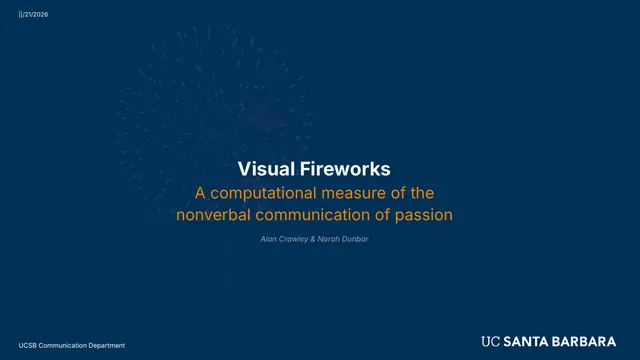
2026Crawley, A., & Dunbar, N. E. Visual fireworks: A computational measure of the nonverbal communication of passion. National Communication Association, Nonverbal Communication Division, New Orleans, LA.Top Paper
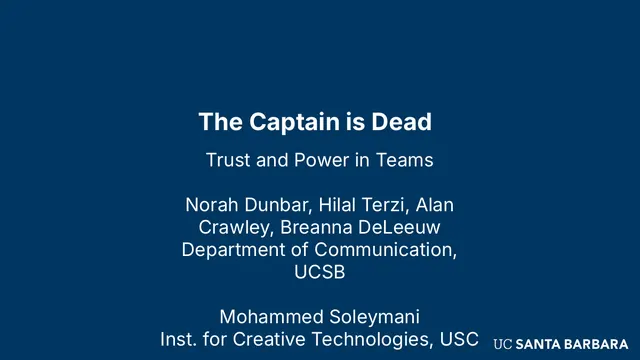
2026Dunbar, N. E., Terzi, H., Crawley, A., DeLeeuw, B., & Soleymani, M. The captain is dead: Trust and power in teams. 19th International Conference on Language and Social Psychology, Tucson, AZ.
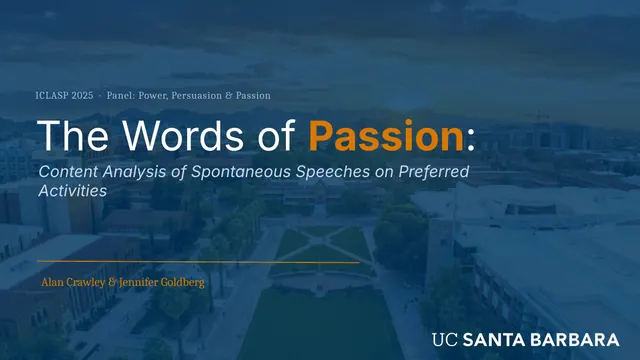
2026Crawley, A., & Goldberg, J. The words of passion: Content analysis of spontaneous speeches on preferred activities. 19th International Conference on Language and Social Psychology, Tucson, AZ.
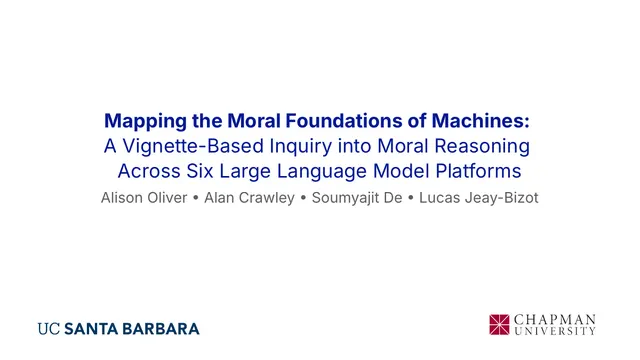
2026Oliver, A., Crawley, A., De, S., & Jeay-Bizot, L. Mapping the moral foundations of machines. 59th Hawaii International Conference on System Sciences, Maui, HI.Top Paper
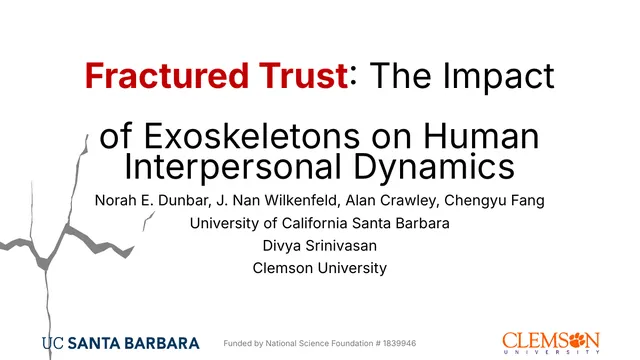
2024Dunbar, N. E., Wilkenfeld, J. N., Crawley, A., Fang, C., & Srinivasan, D. Fractured trust: The impact of exoskeletons on human interpersonal dynamics. 18th International Conference on Language and Social Psychology, Tallinn, Estonia. Funded by the National Science Foundation (#1839946).
00:36
GSA Excellence in Teaching Award, 2025.
“Do it with passion, or not at all.”
Four courses designed and taught as instructor of record, each built from scratch, 2025–2026.
I teach in English and Spanish.
Teaching assistant every quarter since Fall 2023: seven lower-division and three upper-division courses.
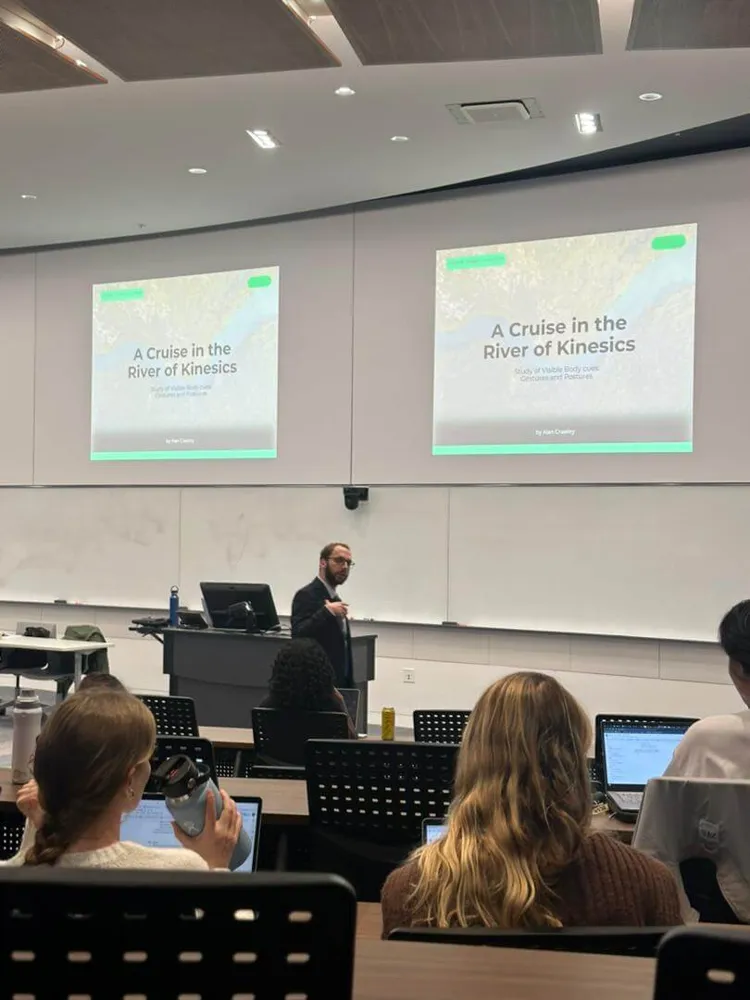
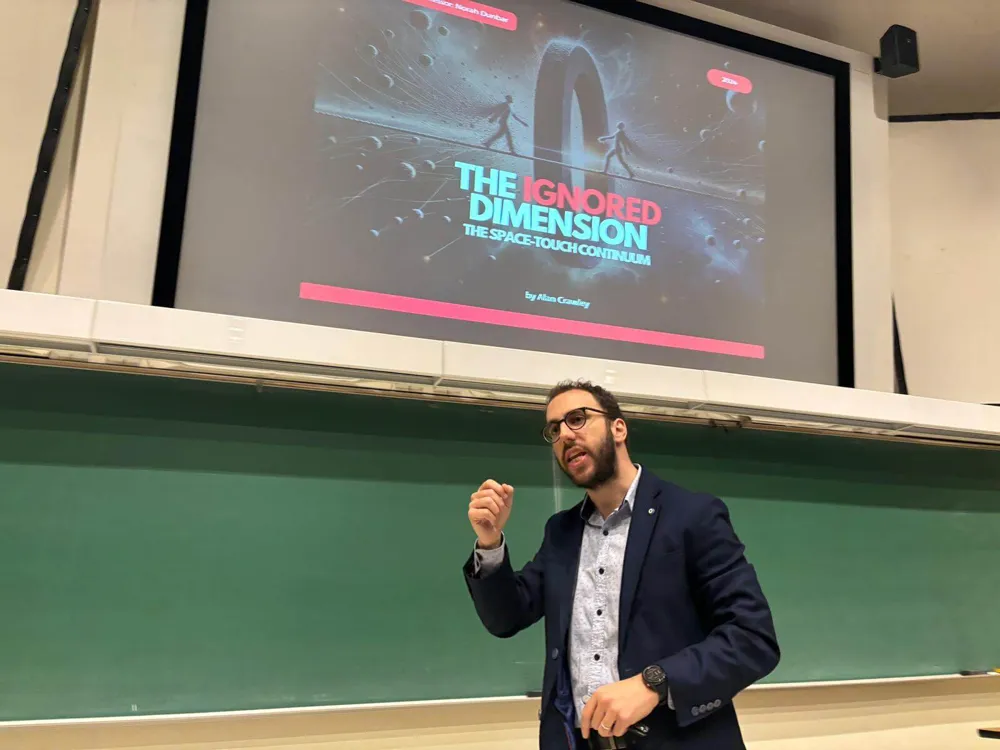
Guest lectures: three in COMM 1 Introduction to Communication, about 300 students each; two in COMM 111 Nonverbal Communication (Winter and Spring 2024); two in COMM 142 Power and Communication (Fall 2024); University of Bern (2023); Universidad de Alcalá (2022).
UCSB end-of-quarter surveys, 1–5 scale (5 = best).
As teaching assistant, by course context
| Item | Lower division n = 26 | Upper division n = 56 | Summer academies n = 48 |
|---|---|---|---|
| Section was well organized | 4.40 | — | 4.26 |
| Explanations of course material | 4.40 | 4.47 | 4.14 |
| Answers to student questions | 4.45 | 4.43 | 4.32 |
| Opportunities for interaction | 4.80 | — | 4.51 |
| Feedback on assignments | 4.30 | 4.24 | 4.50 |
| Learning atmosphere | 4.55 | — | 4.44 |
| Accessible for help | 4.75 | 4.57 | 4.68 |
“He’s created a perfect learning environment for a subject that is often uncomfortable for others.”
“I was surprised to learn this was his first time teaching this course when everything was so well organized and meticulously detailed.”
“He was super engaging, passionate about teaching, and made coming to lecture actually fun.”
“He organized the course in a way that made concepts and topics easier to learn.”
“Seriously one of the best comm professors I’ve had here at UCSB so far.”
“He graded pretty hard, which is a good thing for people looking to improve in their writing and research.”
“He carved out hours to give detailed, insightful feedback on everyone’s essays.”
“It was clear that he genuinely cared about both his students’ academic success and well-being.”
“One of the best lectures I have seen in my time at UCSB.”
Undergraduate research assistants trained and supervised in the lab.
Student research projects directed at the same time in the UCSB Summer Research Academies.
Selected student projects
00:48
Tools and materials I build for research and teaching.
≈ 6,100 papers · 2,187-node taxonomy
A private research system over the nonverbal communication literature: full-text and semantic search, a 14-level taxonomy of the field, a field map of 72 topic tags, and citation verification against the source texts.
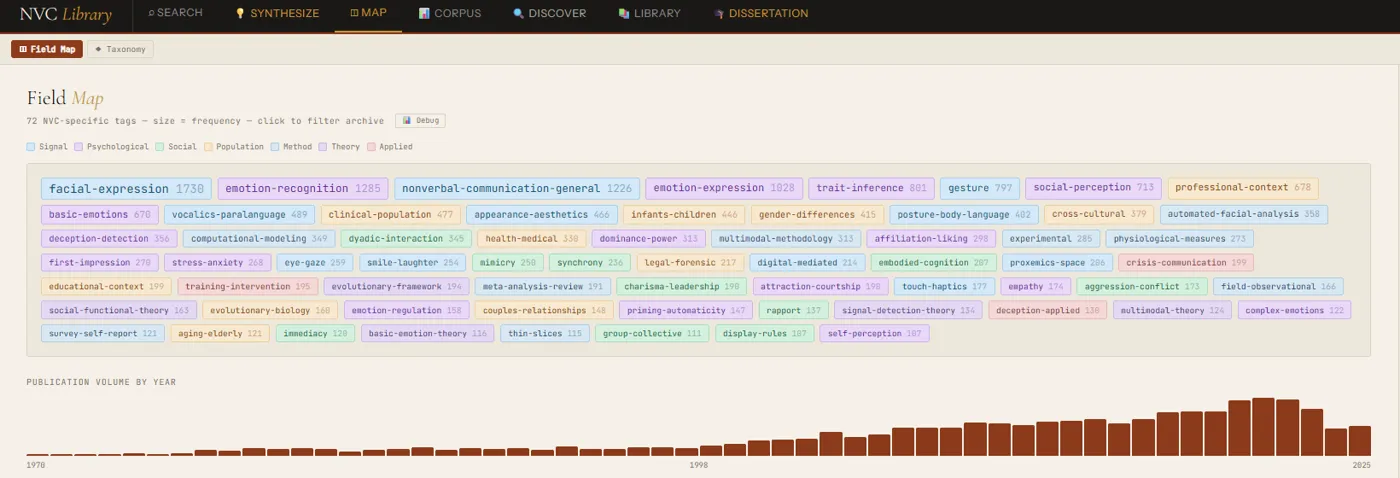
Kinesics · voice
A pipeline that estimates facial, bodily and vocal expressivity from video and audio, built on open-source face and pose tracking.
20 songs
Songs made with generative AI that teach core communication theories, used in discussion sections as memory aids. Listen to the playlist
85 papers · 9 topics
A Spanish-language reading guide built on Plusquellec and Denault’s (2018) bibliometric analysis. Read the guide
00:54
that changed my mind.
Science as a way of thinking rather than a collection of facts, in prose anyone can follow.
The universe coordinates itself without a conductor.
Human behavior studied through the eyes of an animal behaviorist.
Writing with clarity and concision sharpens the ability to think and to express oneself.
The willingness to change your mind is a prerequisite for science.
01:00
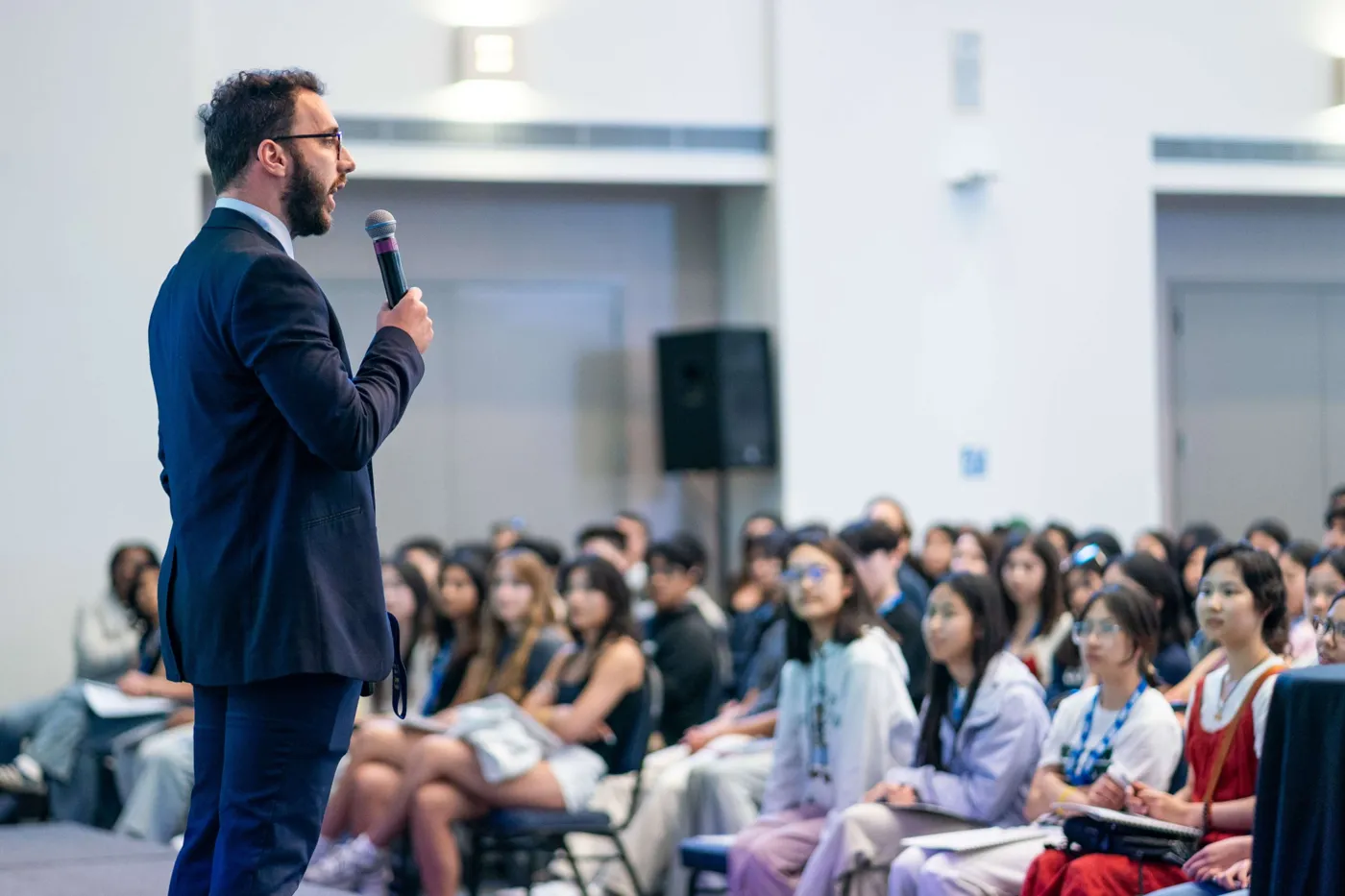
Through Sin Verba I write, record and speak in Spanish about what the science of nonverbal communication knows, and does not know, about “body language”: a blog, a podcast, a YouTube channel, and talks in the United States, Mexico, Colombia, Spain, Switzerland and the Czech Republic.
From 2020 to 2023 I trained more than 60 specialists from over 15 Spanish-speaking countries. With the Behavior & Law Foundation I coordinated the online Certificate in Nonverbal Communication at Heritage University (2021–2023), designed the program of the 2021 International Conference on Nonverbal Communication, and recorded five video lessons for a master’s program in nonverbal behavior.
01:03
Communication Reports
Journal of Leadership & Organizational Studies
Ph.D., Communication (STEM), University of California, Santa BarbaraAdvisor: Norah E. Dunbar
2023–2028 (exp.)M.A., Communication (STEM), University of California, Santa BarbaraThesis: “Nonverbal Fireworks: The Nonverbal Communication of Passion”
2025Licenciatura in Psychology, with honors, Universidad del Salvador, Buenos Aires
2018Diploma in Nonverbal Communication, Universidad Austral, Buenos Aires
2016Certified FACS coder, Paul Ekman Group
2015Top Paper Award, Nonverbal Communication Division, National Communication Association
Top Paper Award, Hawaii International Conference on System Sciences
WAGS/ProQuest Distinguished Master’s Thesis Award, UC Santa Barbara campus winner (Humanities, Social Sciences, Education, and Business)
Excellence in Teaching Award, Graduate Student Association, UC Santa Barbara
Languages: Spanish (native), English (IELTS 8).
01:12
alancrawley@ucsb.edu
Department of Communication, University of California, Santa Barbara, CA 93106